ICYMI: As of February 15, the full Qiskit SDK 1.0 release is now available for installation via PyPI. This blog post will provide Qiskit users with a recap of the key points we originally shared about Qiskit 1.0 via our pre-release announcement in December, as well as new technical information on updates to Qiskit Runtime primitives, and a detailed list of the breaking changes users should be aware of. Be sure to keep an eye out for further communications coming later this year, which will celebrate the official launch of Qiskit’s first major version.
The TL;DR
Qiskit 1.0 is our way of marking the start of a new chapter in the history of quantum programming — one that is centered on performance, stability, and usability. But what does this mean exactly? We’ve made a variety of changes over the past few releases to prepare for this, including:
- A more performant SDK: Qiskit has spent years undergoing improvements to its overall performance, and this release represents the accumulation of many different improvements over the past 18 months. Qiskit 1.0 will enable users to easily build and transpile circuits with 100+ qubits, and lays the groundwork for future 1,000+ qubit workloads.
- A more stable API: With the launch of Qiskit 1.0, we are beginning a new, more stable release cycle and updating our versioning support. Get ready for less frequent breaking changes and much more robust backwards-compatibility and bug support than ever before!
- A leaner set of libraries: We’ve consolidated and focused the core features of Qiskit by removing the metapackage architecture and splitting out several modules into separate packages. This allows us to focus much more on stability and maintainability while enabling the wider open source community to contribute interesting new features. You’ll find more details on why and how we made this decision in our migration guide.
- An SDK built for an open-source ecosystem: The transpiler plugin interface and the broader Qiskit Ecosystem program are designed to encourage scientists, engineers and software developers to try their hand at building new extensions of Qiskit’s core capabilities, so we can all work together to advance the field of quantum computing.
New primitives design
One of the biggest changes that comes with Qiskit 1.0 is a redesign of the Sampler and Estimator primitives in the core SDK, as well as a new release of Qiskit Runtime that implements these updated definitions. These two interfaces play an essential role in enabling users to interact with quantum hardware through Qiskit.
The most significant new feature here is that we’ve introduced new Sampler and Estimator primitives, called SamplerV2 and EstimatorV2, that are designed to accept vectorized inputs. This allows users to perform sweeps over parameter value sets and observables, which in turn makes collecting the results of many combinations of circuits, expectation values, and parameters MUCH easier!
In this context, groups of circuits, parameters, and observables are called Primitive Unified Blocs (PUBs). The new primitives will accept multiple PUBs as input, and each PUB will get its own result — keeping everything contained in just a single runtime object.
Here’s a quick example of the new workflows this enables:
from qiskit_ibm_runtime import QiskitRuntimeService
from qiskit.circuit import Parameter, QuantumCircuit
from qiskit_ibm_runtime import (
    EstimatorV2 as Estimator,
    QiskitRuntimeService,
)
from qiskit.transpiler.preset_passmanagers import generate_preset_pass_manager
from qiskit.quantum_info import Pauli, SparsePauliOp
import numpy as np

# Instantiate runtime service and get
# the least busy backend
service = QiskitRuntimeService()
backend = service.least_busy(operational=True, simulator=False)

# Define a circuit with two parameters.
circuit = QuantumCircuit(2)
circuit.h(0)
circuit.cx(0, 1)
circuit.ry(Parameter("a"), 0)
circuit.rz(Parameter("b"), 0)
circuit.cx(0, 1)
circuit.h(0)

# Transpile the circuit
pm = generate_preset_pass_manager(optimization_level=1, backend=backend)
transpiled_circuit = pm.run(circuit)
layout = transpiled_circuit.layout


# Now define a sweep over parameter values, where the two axes are over the
# two parameters in the circuit.
params = np.vstack(
    [
        np.linspace(-np.pi, np.pi, 100),
        np.linspace(-4 * np.pi, 4 * np.pi, 100),
    ]
).T

# Define three observables. The inner length-1 lists cause this array of
# observables to have shape (3, 1), rather than shape (3,) if they were
# omitted.
observables = [
    [SparsePauliOp(["XX", "IY"], [0.5, 0.5])],
    [SparsePauliOp("XX")],
    [SparsePauliOp("IY")],
]
# Apply the same layout as the transpiled circuit.
observables = [
    [observable.apply_layout(layout) for observable in observable_set]
    for observable_set in observables
]

# Estimate the expectation value for all 300 combinations of observables
# and parameter values, where the pub result will have shape (3, 100).
#
# This shape is due to our array of parameter bindings having shape
# (100, 2), combined with our array of observables having shape (3, 1).
pub = (transpiled_circuit, observables, params)

# Instantiate the new estimator object, then run the transpiled circuit
# using the set of parameters and observables.
estimator = Estimator(backend)
job = estimator.run([pub])
result = job.result()

# Print out the results and job metadata
print(f" > Expectation value: {result[0].data.evs}")
print(f" > Metadata: {result[0].metadata}")The new primitives also come with a few other changes, mainly:
- The estimator now possesses a
precisionargument in therun()method which specifies a targeted precision for the expectation value estimates. - Similarly, the sampler has moved the
shotsargument from the options of the primitive definition into the arguments of therun()method. - The new Sampler will also return the measurement outcome of every shot (in the order they were measured) instead of the (quasi-)probability distribution — allowing more flexibility in how you post-process the results from your jobs.
Native OpenQASM 3 support
Qiskit now offers an experimental native OpenQASM 3 parser to dump and load ‘QuantumCircuit’ objects. The parser has been overhauled and written in Rust, giving users the ability to load OpenQASM 3 instructions significantly faster. We’ve also removed the qiskit.qasm module and separated it into qiskit.qasm2 and qiskit.qasm3.
The example below shows how you can create a RealAmplitudes circuit with 20,000 instructions, dump it into a file, and then time how long the file takes to load. Users will need to pip install qiskit_qasm3_import to run the code block.
import numpy as np
import qiskit.qasm3
from qiskit.circuit.library import RealAmplitudes


qc = RealAmplitudes(100, reps=100, flatten=True)
qc = qc.assign_parameters(np.random.rand(qc.num_parameters))
oq3 = qiskit.qasm3.dumps(qc)

with open('test.qasm', 'w') as ofile:
    qiskit.qasm3.dump(qc, ofile)

import time
start_time = time.time()
old_qasm = qiskit.qasm3.load('test.qasm')
print('Old Qasm 3 took: {}'.format(time.time() - start_time))

start_time = time.time()
new_qasm = qiskit.qasm3.load_experimental('test.qasm')
print('New Qasm 3 took: {}'.format(time.time() - start_time))On a ThinkPad P1 (11th gen i7-11850H), the old parser takes approximately 7 seconds to load, while the new parser requires just over 200ms to execute. Quite the speedup!
At the moment, this fast parser is experimental and might not support all the instructions in the extensive OpenQASM 3.0 specification. Submit a feature request to let us know which instructions we should support next.
A generic fake backend module
The recent announcement of the new IBM® Quantum Heron processors and the IBM Quantum System Two™ design means Qiskit needs the ability to support dynamic circuits and disjoint qubit coupling maps. The 1.0 release includes this functionality along with a new GenericBackendV2 class within the qiskit.providers.fake_provider module.
This new class allows users to easily configure and build custom BackendV2 instances that can be run locally. The number of qubits, the coupling map, the basis gates, the instruction calibrations, the ability to run dynamic circuits (also known as control flow operations), and the measurement timestep can all be customized without manually constructing a Target object.
It’s important to note that we aren’t announcing full support for multi-QPU backends just yet. However, these new capabilities represent an important step towards that goal, and their rollout here means we’re on track in maintaining progress outlined in our roadmap.
See below for a quick example of the feature in action. We encourage you to experiment with this in your own workflows and start designing circuits to be run on disjoint qubit lattices.
from qiskit import QuantumCircuit, ClassicalRegister, transpile
from qiskit.providers.fake_provider import GenericBackendV2

# Create a circuit with classical control
creg = ClassicalRegister(19)
qc = QuantumCircuit(25)
qc.add_register(creg)
qc.h(0)
for i in range(18):
    qc.cx(0, i + 1)
for i in range(18):
    qc.measure(i, creg[i])
with qc.if_test((creg, 0)):
    qc.ecr(20, 21)

# Define backend with custom basis gates and
# control flow instructions
backend = GenericBackendV2(
    num_qubits=25,
    basis_gates=["ecr", "id", "rz", "sx", "x"],
    control_flow=True,
  )

#Transpile
transpiled_qc = transpile(qc, backend)A release lifecycle with more stability
The transition to Qiskit 1.0 also means the Qiskit SDK development cycle is changing. Instead of the frequent breaking changes of the 0.* era, there will now be a minimum of one year between major releases (where breaking changes will occur), and minor version releases will continue to occur as usual at a rate of once every three months.
More specifically, the Qiskit SDK is fully adopting the Semantic Versioning 2.0.0 design scheme, which is made up of three version components represented as major, minor, and patch versions (written as X.Y.Z). You’ll find a tentative release schedule below, which highlights the points at which these change will take place. Take a look at the corresponding docs page here if you’d like to learn more.
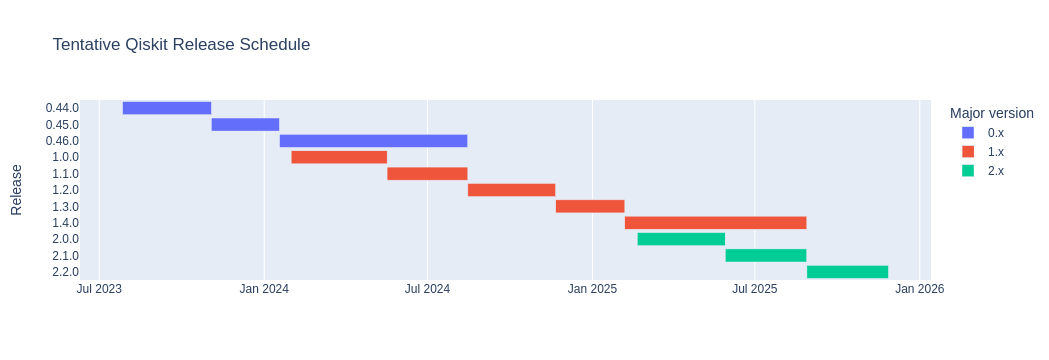
New major versions (the X in the X.Y.Z format) will come out once a year and will be the only release during our update cycle that will contain breaking changes to the Qiskit SDK. After a major release, the previous major version will be supported for an additional 6 months to allow folks time to transition between versions.
In between major versions, we’ll release minor versions (Y) approximately once every 3 months to deploy new backwards-compatible features or enhancements. Bug support for previous minor releases will come to an end once a new one is published, so be sure to keep your minor version updated! However, we don’t anticipate this will cause many issues for users because none of these releases will contain any breaking changes.
Finally, we’ll release patch versions (Z) to publish backwards-compatible bug fixes. These releases will only come out as needed when we identify bugs or other issues. No new deprecations, features, or public API changes will be made between these patch versions.
This new release cycle applies only to the Qiskit SDK — not other Qiskit technologies.
Memory & performance
Qiskit 1.0 comes with some hefty memory and performance improvements. However, we know it’s not enough to just say “Qiskit is more performant now!” and leave it there. So, let’s take a deeper look at how Qiskit 1.0 improves upon the performance of its predecessors. Here, we’ll focus on two main metrics: memory and speed.
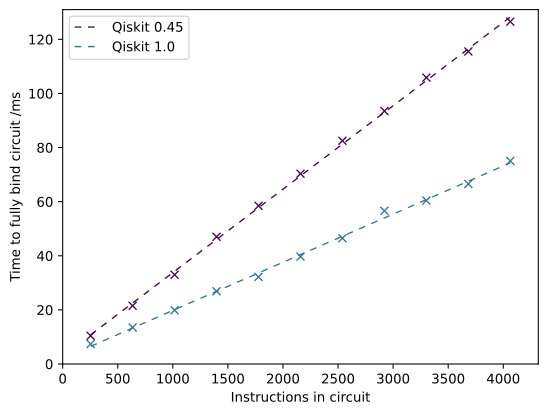
In terms of speed, many features in Qiskit 1.0 are much faster now than they were in the past, due in large part to ongoing internal refactoring and the introduction of Rust code under the hood. For example, the transpiler in Qiskit 1.0 can bind and transpile circuits 39x faster than Qiskit 0.33, while also returning shorter circuit depths as an added bonus. The plot below depicts the amount of time required to bind the parameters of an EfficientSU2 circuit as the number of parameters increases using the 1.0 release, and compares that against the (0.45) release:
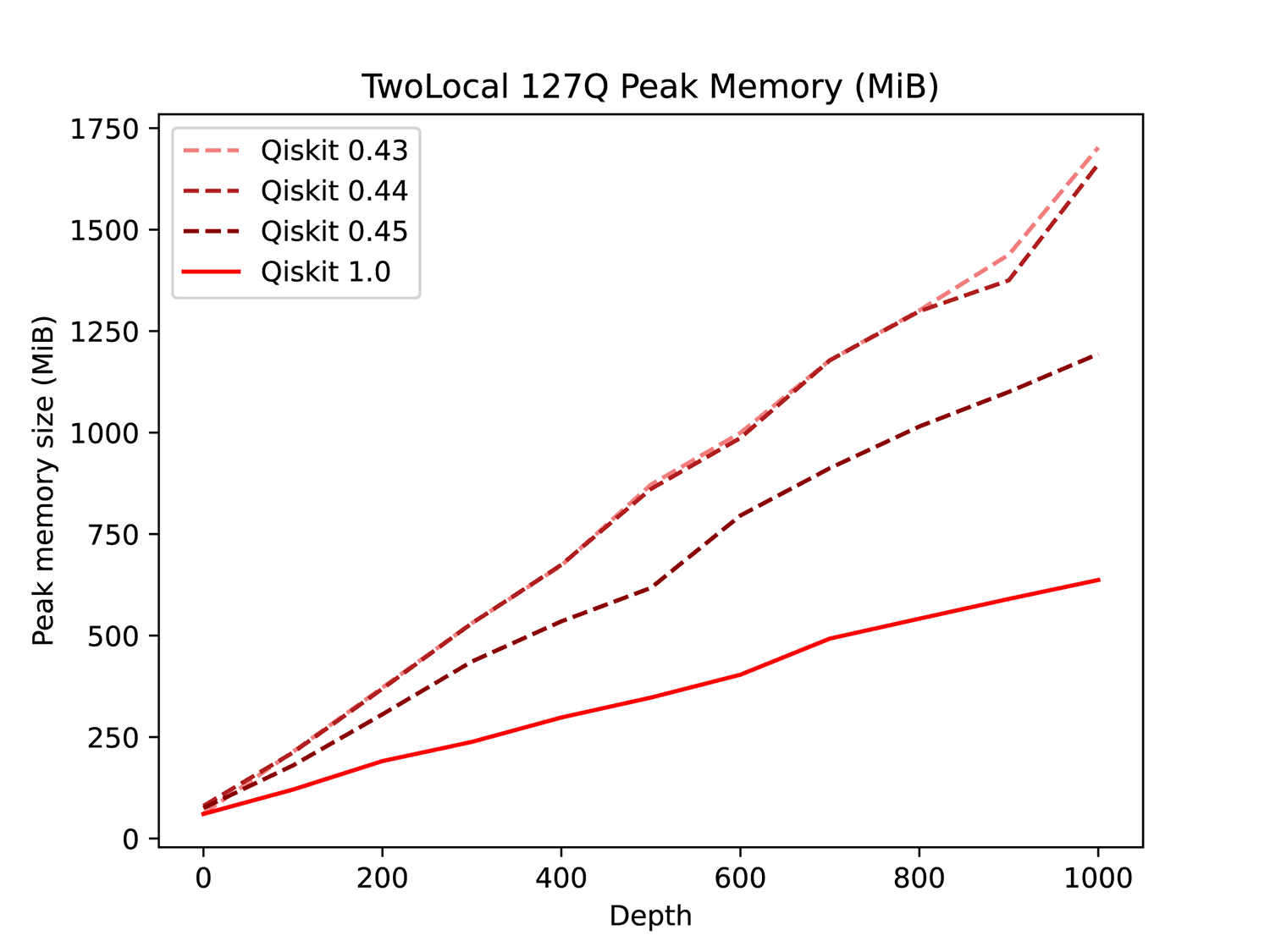
Similarly, when it comes to memory, we’ve done a lot of internal refactoring to reduce the footprint of circuits, with Qiskit 1.0 demonstrating an average 55% decrease in memory usage compared to Qiskit 0.39. The chart below shows data collected on the maximum memory used in building a 127-qubit Two Local circuit at increasing circuit depth, comparing the last three Qiskit versions against version 1.0:
Breaking changes
Here, we’ll highlight any changes that could cause users' existing code to break when updating to this latest version, such as deprecated classes/functions that have now been removed. This was motivated by a push to clean up and create a “leaner,” more trimmed down Qiskit. If there’s a particular change you want to learn more about, be sure to check our release notes and migration guide.
The change most likely to impact your projects is actually one found in the qiskit-ibm-runtime primitives, and is related to how jobs are submitted to our backends. Moving forward, Qiskit Runtime will require all circuits and observables users submit to employ only instructions supported by the system (referred to as Instruction Set Architecture or ISA). This essentially means you’ll have to make sure your circuits are transpiled against a backend and respect both its basis gates and coupling map. Otherwise, the job will fail.
There are also a number of smaller breaking changes in our migration guide that we think are worth highlighting in this post, including:
- Users can no longer import the
qiskit.Aerobject fromqiskit. Instead, users must install the Qiskit Ecosystem packageqiskit-aer, and then importqiskit_aer.Aer. - Similarly, we’ve moved the
qiskit.BasicAermodule toqiskit.providers.basic_providerand renamed a few of its classes. - We’ve removed the
qiskit.execute()function. This was a wrapper around the run and transpile functionalities, so now you’ll have to runtranspile— with the appropriate options — followed bybackend.run(). - The method
.QuantumCircuit.qasmshould be replaced with either theqasm2.dumpor theqasm3.dump(or, if you prefer strings as output,dumps()) method instead. - A number of gate methods have been removed in favor of more established methods which accomplish the same thing:
| Removed | Alternative |
|---|---|
QuantumCircuit.cnot | QuantumCircuit.cx |
QuantumCircuit.toffoli | QuantumCircuit.ccx |
QuantumCircuit.fredkin | QuantumCircuit.cswap |
QuantumCircuit.mct | QuantumCircuit.mcx |
QuantumCircuit.i | QuantumCircuit.id |
QuantumCircuit.squ | QuantumCircuit.unitary |
- Additionally, the following gate methods have been removed and instead can only be applied using the
QuantumCircuit.appendmethod.
| Removed | Alternative |
|---|---|
QuantumCircuit.diagonal | DiagonalGate |
QuantumCircuit.hamiltonian | HamiltonianGate |
QuantumCircuit.isometry | Isometry |
QuantumCircuit.iso | Isometry |
QuantumCircuit.uc | UCCGate |
QuantumCircuit.ucrx | UCRXGate |
QuantumCircuit.ucry | UCRYGate |
QuantumCircuit.ucrz | UCRZGate |
- The
QuantumCircuit.bind_parameters()method has been moved toQuantumCircuit.assign_parameters. - The
QuantumCircuit.snapshothas been replaced withqiskit-aer’ssave instructions. - We’ve removed the
qiskit.converters.ast_to_dag. Previously it was used to convert the abstract syntax tree generated by OpenQASM 2. If you were using this, you can instead parse your OpenQASM 2 files into aQuantumCircuitusingQuantumCircuit.from_qasm_file()orQuantumCircuit.from_qasm_string(), and then convert theQuantumCircuitinto a DAG using.circuit_to_dag(). - The
qiskit.extensionsmodule has been removed. Most of its classes now belong toqiskit.circuit.libraryexcept for the following:SingleQubitUnitarySnapshotExtensionError
- Most of the
qiskit.providers.fake_providerhave been migrated into the new version ofqiskit-ibm-runtime. For the most part you should be able to replace the import statementqiskit.providers.fake_providerwithqiskit_ibm_runtime.fake_provider. - We’ve removed the
qiskit.pulse.library.parametric_pulsesand many of the discrete pulse library objects. - We’ve removed
qiskit.quantum_info.synthesisand migrated its functionality to a few different locations, but most of them are now inqiskit.synthesis. - We’ve removed the
qiskit.toolsmodule as most of its functionality was either replaced or could be found elsewhere. The primary exception here is theqiskit.tools.parallel_map()function which has been moved toqiskit.utils. - We’ve moved a few items in the
qiskit.transpiler.synthesismodule to new locations:
| Removed | Alternative |
|---|---|
qiskit.transpiler.aqc (except for AQCSynthesisPlugin) | qiskit.synthesis.unitary.aqc |
qiskit.transpiler.synthesis.graysynth | qiskit.synthesis.synth_cnot_phase_aam |
qiskit.transpiler.synthesis.cnot_synth | qiskit.synthesis.synth_cnot_count_full_pmh |
- The
CrossTalkAdaptiveScheduletranspiler pass has been removed from Qiskit as it was no longer usable. - The
NoiseAdaptiveLayouttranspiler pass has been removed and is superseded byVF2LayoutandVF2PostLayout. - We’ve removed the following
qiskit.utilstools:qiskit.utils.arithemeticqiskit.utils.circuit_utilsqiskit.utils.entangler_mapqiskit.utils.name_unamed_args.
- We’ve removed
qiskit.visualization.qcstyle. Users should instead useqiskit.visualizaiton.circuit.qcstyleas a direct replacement.
How to upgrade to Qiskit 1.0
If you are new to Qiskit and are just now joining us on your quantum journey, there’s no need to worry too much about all these changes. Just pip install qiskit and you’ll be ready to go!
For existing users, the situation is a bit more complicated. Qiskit 1.0 uses a new packaging structure, and you will not be able to upgrade an existing Qiskit 0.x installation to Qiskit 1.0 in-place. You’ll have to create a new conda/pip/poetry environment and add the dependency either as qiskit or qiskit>=1.0 to use the 1.0 release. This is the only time we expect to break packaging; you will be able to upgrade from Qiskit 1.0 and beyond in-place.
If you maintain a package that uses qiskit as a dependency, check out this section of the migration guide for guidance on how to transition your package to support Qiskit 1.0. And for users of projects that depend on Qiskit, please be patient with your maintainers! It’s a lot of work to support new versions of libraries, and it can take time to switch over.
For project maintainers, we recommend you first upgrade your dependency to 0.46 before refactoring your codebase to support 1.0. The 0.46 release includes quite a few new deprecation warnings and will likely make the transition to 1.0 smoother for your project. And don’t worry if you need extra time to deal with those deprecation warnings. With the new release cycle, you’ll have 6 months of full support for version 0.46.
Conclusion
So, there you have it — the most important details of the first stable version of Qiskit. We’ve only covered the main highlights of the changes here. If you’d like to learn more details, be sure to check out the release notes and migration guide to orient yourself to the new version.
Remember, if you want to put ideas forward for future versions of Qiskit, you can always open a GitHub issue to request a feature or report a bug. And if you want to follow what's coming up in the next releases, check out the Qiskit milestones here.
We are incredibly grateful to everyone who has taken the time over the past six-and-a-half years to contribute to Qiskit, and to everyone who has taken part in the work that has led us to this moment. Whether it was a pull request, bug report, or just a comment on slack, your contributions make a difference. Please keep it up! We are very proud of how far we’ve come, and can’t wait to embark on this next phase of our development journey with your continued support.
And as a special one-off to celebrate all of the work our open-source community has contributed over the years, we’d like to list and thank everyone who has contributed to this codebase since day 1. Whether your contribution was big or small, we are immensely appreciative of this community and all of the work you have done to help continue to improve Qiskit. We’d like to thank (in alphabetical order):
Abby Mitchell, Abdulah Amer, Abdullah Ash-Saki, Abdón Rodríguez Davila,
Abhik Banerjee,  Abhiraj Shrotriya, Abhishek K M, Abigail J. Cross,
Abraham Asfaw, Adam Carriker, Adenilton Silva, Adish Vartak,
Adrian Chen, Adrien Suau, Adrin Jalali, Akash M, Akshay Kale,
Albert  Frisch, Alberto Espiricueta, Alberto Maldonado,
Alejandro Martinez Valencia, Alejandro  Montanez, Aleksei Malyshev,
Alex Zhang, Alexander Ivrii, Alexander Miessen, Ali Javadi- Abhari,
Almudena Carrera Vazquez, Aman Bansal, Amol Deshmukh, Andreas Fuhrer,
Andrew  Meyer, Andrew W. Cross, André Großardt, Angelo Danducci,
Aniket Patil, Animesh N.  Dangwal, Aniruddha Sarkar, Anirudh Rao,
Anna Phan, Annanay Kapila, Anthony Gandon,  Anton Dekusar,
Anton Karazeev, Antonio D. Córcoles-Gonzales, Antonio Mezzacapo,
Areeq  Hasan, Arfat Salman, Arianna Crippa, Arijit Saha, Arjun Bhobe,
Artemiy Burov, Arthur  Strauss, Artur Avkhadiev, Arun Raja,
Ashish Barnawal, Ashish Panigrahi, Atsushi Matsuo, Aurélien Pupier,
Austin Gilliam, Axel Hernández Ferrera, Azeem Bande-Ali, Aziz Ngoueya,
Bartłomiej Stępień, Ben Rosand, Ben Zindorf, Bhargav Vishnu,
Blake Johnson, Blesso  Abraham, Bochen “Daniel” Tan, Borja Godoy Gago,
Bruno E. Ramírez Galindo, Bruno  Schmitt, Bryce Fuller, Caleb Clothier,
Caleb Johnson, Caleb Smith, Cameron McGarry,  Carmen Recio Valcarce,
Caroline Tornow, Charles Taylor, Chih-Han Huang, Chris Culver,
Chris Harris, Chris Schnabel, Christa Zoufal, Christian Clauss,
Christina Lee, Christophe  Vuillot, Christopher J. Wood,
Christopher Zachow, Claudia Zendejas-Morales, Claudio  Gambella,
Clemens Possel, Colin Hong, Connor Howington, Corey Mendell,
Cristian Emiliano  Godinez Ramirez, Daiki Murata, Dani Guijo,
Daniel Aja, Daniel Bevenius, Daniel Choi, Daniel  Egger,
Daniel Puzzuoli, Daniyar Yeralin, Dariusz Lasecki, David Ittah,
David McKay, David  Nadlinger, Davide Facoetti, Davide Ferrari,
Declan Millar, Deeksha Singh, Delton Ding,  Dennis Liu,
Desiree Vogt-Lee, Dhruv Bhatnagar, Diego Emilio Serrano,
Diego M. Rodríguez,  Diego Ristè, Dimitar Trenev, Divyanshu Singh,
Dmitri Maslov, Dolph Mathews, Donny  Greenberg, Douglas T. McClure,
Doğukan Tuna, Drew Risinger, Duong H. D, Eddie Schoute,  Edward H. Chen,
Edwin Navarro, Elena Peña Tapia, Eli Arbel, Emil Magni, Enrique Lacal,
Enrique de la Torre, Eric Arellano, Eric Eastman, Eric Peterson,
Erick Winston, Etienne  Wodey, Eugene Dumitrescu, Evan McKinney,
Evgenii Zheltonozhskii, Faisal Debouni, Farai  Mazhandu, Felix Truger,
Filipe Correa, Filippo Tramonto, Fran Cabrera, Francesco Piro,
Franck Chevallier, Frank Harkins, Freya Shah, Gabriel Monteiro,
Gabriele Agliardi, Gadi  Aleksandrowicz, George Barron, George Zhou,
Georgios Tsilimigkounakis, Giacomo  Nannicini, Giacomo Ranieri,
Gian Gentinetta, Ginés Carrascal, Grant Eberle, Gushu Li,  Haggai Landa,
Hanhee Paik, Harshit Gupta, Haruki Imai, Hayk Sargsyan, Helena Zhang,
Henry Zou, Hirmay Sandesara, Hiroshi Horii, Hristo Georgiev,
Hugo van Kemenade, Hunter  Kemeny, Héctor Abraham, Ian Hincks,
Igor Olegovich Sokolov, Igor Sokolov, Ikko Eltociear  Ashimine,
Ikko Hamamura, Iman Elsayed, Isaac Cilia Attard, Isha Rajput,
Iskandar Sitdikov,  Ismael Faro Sertage, Ismail Yunus Akhalwaya,
Israel F. Araujo, Iulia Zidaru, Ivan Carvalho,  Ivan Duran,
Jack J. Woehr, Jake Lishman, James R. Garrison, James Seaward,
James  Weaver, James Wootton, Jason Ricciardi, Jay M. Gambetta,
Jeevesh Krishna, Jerry M. Chow,  Jesse Gorzinski, Jessica Wilson,
Jessie Yu, Jesús Pérez, Jesús Sistos, Jielun (Chris) Chen,
Jimmy Yao, Jintao YU, Joachim Schwarm, Joe Hellmers, Joe Latone,
Johan Nicander,  Johannes Weidenfeller, John A. Smolin, John Judge,
John Lapeyre, Jonathan A. Wildstrom, Jonathan Daniel,
Jonathan Shoemaker, Joonghoon Lee, Jordan Connor, Jorge Carballo,
Joseph McElroy, Josh Kelso, Joshua Manela, Juan Cruz-Benito,
Juan Gomez-Mosquera,  Juan Luis Sánchez Toural, Julian Schuhmacher,
Julien Gacon, Jun Doi, Junya Nakamura,  Junye Huang, Kareem EL-Safty,
Kartik Chinda, Kaushik Chintam, Kazuaki Ishizaki, Kazuki  Tsuoka,
Kazumasa Umezawa, Ken Nakanishi, Kenso Trabing, Kento Ueda,
Kevin Hartman,  Kevin J. Sung, Kevin Krsulich, Kevin Tian, Kiran Johns,
Kuba Pilch, Kunal Marwaha, Kyle  Lund, Laura Zdanski, Lauren Capelluto,
Lebin Yu, Lee James O`Riordan, Lev S. Bishop, Liam  Madden,
Luciano Bello, Luis Garcia, Lukas Burgholzer, Łukasz Herok,
M St, M. Chandler  Bennett, MD SAJID ANIS, Melvin George, Maddy Tod,
Madhav Jivrajani, Magnus Berg  Sletfjerding, Mahnoor Fatima,
Makoto Suwama, Manoel Marques, Mantas Čepulkovskis,  Marc Sanz Drudis,
Marcello La Rocca, Marco Pistoia, Mario Motta, Mark Everitt,
Martin  Sandberg, Mathieu Tillet, Matt Stypulkoski, Matt Wright,
Matthew Amy, Matthew Scott  Conroy, Matthew Treinish,
Matthieu Dartiailh, Mattia Ippoliti, Maureen McElaney, Max Reuter,
Max Rossmannek, Mehmet Keçeci, Michał Górny, Milos Prokop, Mingi Ryu,
Mirko Amico,  Miroslav Tomasik, Mohamed El Mandouh, Mohammad Shoaib,
Mohit Deshpande, Mu-Te  Joshua Lau, NEETIMAN KAR, Nahum Rosa Cruz Sa,
Naoki Kanazawa, Nathan Shammah,  Navaneeth D, Nick Bronn, Niko Savola,
Ninad Sathaye, Nipun Ramagiri, Nir Gavrielov,  Oluwatobi Ogunbayo,
Omar Costa Hamido, Oskar Słowik, Prathamesh Bhole,
Paco Martín  Fernández, Panagiotis Barkoutsos, Paolo Bianchini,
Parmeet Singh, Patrick Downing, Patrick  Neuweiler, Paul Kassebaum,
Paul Nation, Paul Schweigert, Pauline Ollitrault, Payal D. Solanki,
Pedro Rivero, Peng Liu, Pete Taylour, Peter J, Philipp Seitz,
Pierre Pocreau, Pieter Eendebak,  Polly Shaw, Pradeep Krishnamurthy,
Pradeep Niroula, Prajjwal Vijaywargiya, Prakash Murali,
Prakhar Bhatnagar, Pranay Barkataki, Priti Ashvin Shah, Qian Jianhua,
Qiskit Bot, R K  Rupesh, Raban Iten, Rafael Martín-Cuevas Redondo,
Rafaella Vale, Rafal Wieczorek, Rafał  Pracht, Rafey Iqbal Rahman,
Rajiv Krishnakumar, Raphaël Lambert, Rathish Cholarajan, Raul  Otaolea,
Raynel Sanchez, Reinhard Stahn, Renier Morales, Richard Chen,
Richard Rodenbusch, Richard Young, Rishabh Chakrabarti,
Rochisha Agarwal, Rohan Sharma, Rohit  Taeja, Romain Fouilland,
Romain Moyard, Romilly Cocking, Roshan Rajeev, Rudy Raymond, Ryan Hill,
Ryan Wood, Ryuhei Yoshida, Sagar Pahwa, Salvador de la Puente González,
Samuel Bosch, Sankalp Sanand, Santanu Banerjee, Santhosh G S,
Saurav Maheshkar, Scott  Johnstun, Scott Kelso, Scott Lawrence,
Scott Wyman Neagle, Sean Dague, Sebastian Brandhofer,
Seemanta Bhattacharjee, Seif Mostafa, Seyon Sivarajah, Shaohan Hu,
Shaojun  Sun, Shelly Garion, Shilpa Mahato, Shion Fukuzawa,
Shivalee RK Shah, Simon Roy, Simone  Gasperini, Soham Bopardikar,
Soham Pal, Soolu Thomas, Soon Teh, Spencer Churchill,
Sristy Sangskriti, Srujan Meesala, Stefan Woerner, Stephen Wood,
Sumit Puri, Sumit Suresh  Kale, Surav Shrestha, Susheel Thapa,
Takashi Imamichi, Takumi Kato, Tamiya Onodera, Tan  Jun Liang,
Tanvesh Takawale, Tanya Garg, Tareq El Dandachi, Tharrmashastha SAPV,
Thomas Alexander, Thomas Metcalfe, Tim Gates, Tobias Kehrer, Tommy Chu,
Toshinari  Itoko, Tristan NEMOZ, Tsafrir Armon, Unchun Yang, Vicente P. Soloviev,
Victor Villar, Viktor Prutyanov,  Vincent R. Pascuzzi, Vishal Bajpe,
Vishnu Ajith, Vismai Khanderao, Vojtech Havlicek, Wahaj  Javed, Wei Hu,
Wen Guan, Wes Turner, Will Bang, Will Shanks, Willers Yang, Xueyan Niu,
Yael Ben-Haim, Yotam Vaknin, Yuchen Pang, Yukio Siraichi, Yunho Maeng,
Yunong Shi, Yuri  Kobayashi, Zachary Crockett, Zachary Schoenfeld,
Zain Mughal & Zlatko Minev.This blog post was written by Kaelyn Ferris with contributions from Abby Mitchell, Blake Johnson, Jake Lishman, Kevin Krsulich, Leron Gil, Luciano Bello and Robert Davis.


