POWER7 information

Removing and replacing a PCI adapter in the 8233-E8B and 8236-E8C server, with the power on in the AIX environment

You can replace a PCI adapter with the system power on in the AIX® environment.

If your system is managed by an HMC, use the HMC to complete the steps for replacing the part in the system. For instructions, see Replacing a part by using the HMC.

Read the following notes to determine if this is the correct procedure for the task to be performed.

Notes:

If you do not have an HMC, complete the following steps to replace a PCI adapter with the system power on in the AIX environment:

  1. Complete the prerequisite tasks that are described in Before you begin.
  2. Take appropriate precautions for avoiding electric shock and handling static-sensitive devices. For information, see Avoiding electric shock and Handling static-sensitive devices.
  3. If you are removing a failing PCIe adapter, identify the failing part. For instructions, see Identifying a part. If you are removing the PCI adapter for other reasons, continue to the next step.
  4. If you are installing, removing, or replacing a PCI adapter in a rack-mounted system, follow these steps to remove the service access cover.
    1. Open the front rack door.
    2. Place the system unit in the service position.
    3. Remove or open the service access cover.
  5. Follow these steps to replace a PCI adapter using the PCI Hot-Plug Manager menu in the AIX Diagnostic tools:
    1. Enter the system diagnostics by logging in as root user or as the celogin user, type diag at the AIX command line.
    2. When the DIAGNOSTIC OPERATING INSTRUCTIONS menu displays, press Enter.
    3. At the FUNCTION SELECTION menu, select Task Selection, then press Enter.
    4. At the Task Selection list, select PCI Hot Plug Manager.
    5. Select Unconfigure a Device, then press Enter.
    6. Press F4 (or Esc +4) to display the Device Names menu.
    7. Select the adapter you are removing in the Device Names menu.
    8. Use the Tab key to answer YES to Keep Definition. Use the Tab key again to answer YES to Unconfigure Child Devices, then press Enter. The ARE YOU SURE window displays.
    9. Press Enter to verify the information. Successful unconfiguration is indicated by the OK message displayed next to the Command field at the top of the screen.
    10. Press F3 (or Esc +3) twice to return to the Hot Plug Manager menu.
    11. Select Replace/remove PCI Hot Plug adapter.
    12. Select the slot that has the device to be removed from the system.
    13. Select Replace. A fast-blinking amber LED located at the back of the machine near the adapter indicates that the slot has been identified.
    14. Press Enter. This places the adapter in the action state, meaning it is ready to be removed from the system.
  6. Label, and then disconnect all cables attached to the adapter you plan to remove.
  7. Slide the adapter latch (A) into the open position, as shown in the following figure.
    Figure 1. PCI adapter or filler plate removed from the rack-mounted system unit
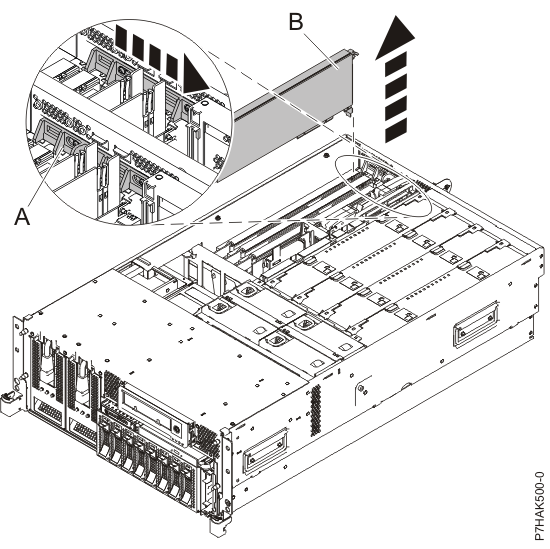
    Adapter or filler plate removed from the system unit.
  8. Carefully grasp the PCI adapter (B) by its top edge or upper corners, and remove it from the system. Store the adapter in a safe place.
  9. If necessary, remove the replacement adapter from the antistatic package.
    Attention: Avoid touching the components and gold connectors on the adapter.
  10. Carefully grasp the adapter by its top edge, and align the adapter with the expansion slot and its connector on the system backplane.
  11. Press the adapter (A) firmly into its connector. See the following figure.
    Attention: When you install an adapter into the system, be sure that it is completely and correctly seated in its connector.
  12. Slide the adapter latch (B) back into place as shown in the following figure.
    Figure 2. PCI adapter replaced in the rack-mounted system unit
    Adapter or filler plate replaced in the system unit.
  13. Connect the adapter cables.
  14. Press enter and continue to follow the instructions in the system diagnostics until you receive a message that the replacement is successful. Successful replacement is indicated by the OK message displayed next to the Command field at the top of the menu.
  15. Press the F3 (or Esc+3) key to return to the PCI Hot-Plug Manager menu.
  16. Press the F3 (or Esc+3) key to return to the TASK selection list.
  17. Select Log Repair Action.
  18. Select the resource just replaced, press Enter, press Commit (F7 or ESC 7), then press Enter.
  19. Press F3 (or Esc+3) to return to TASK Selection List.
  20. Select Hot Plug Task, press enter.
  21. Select PCI Hot Plug Manager, then select Configure a defined device, then press Enter.
  22. Select the device just replaced from the list, then press Enter. The device is now configured.
  23. Press the F10 key to exit the diagnostic program.
    Note: If you are running the stand-alone diagnostics, do not exit the program completely.
  24. Verify the PCI adapter by using the following instructions:
    1. Did you replace the adapter with the system power on?
      • Yes - Go to the next step.
      • No - Load the diagnostic program by doing the following:
        • If AIX is available, boot AIX, log in as root or CELOGIN, then enter the diag command.
        • If AIX is not available, boot the stand-alone diagnostics
    2. Type the diag command if you are not already displaying the diagnostic menus
    3. Select Advance Diagnostic Routines, then select Problem Determination.
    4. Select the name of the resource just replaced from the menu. If the resource just replaced is not shown, choose the resource associated with it. Press Enter, then press Commit ((F7 or Esc+7)).
    5. Did the Problem Determination identify any problems?
      • No: Continue to the next step.
      • Yes: A problem is identified
        • If you are a customer, record the error information, then contact your service provider.
        • If you are an authorized service provider, return to map 210-5.
  25. Press the F10 key to exit the diagnostic program.
  26. Replace or close the service access cover and, if applicable, return the system to the operating position.
  27. Verify the installed part.
    • If you replaced the part because of a service action, verify the installed part. For instructions, see Verifying a repair.
    • If you installed the part for any other reason, verify the installed part. For instructions, see Verifying the installed part.


Send feedback Rate this page

Last updated: Thu, January 10, 2019