Cluster Manager and Clinfo
The Cluster Manager daemon (clstrmgr) is an PowerHA® SystemMirror® subsystem that monitors a cluster and initiates recovery actions if necessary. The Cluster Manager reports on cluster behavior so that other programs can determine if changes have occurred within the cluster and if necessary, respond to those changes.
Once the Cluster Manager gets the cluster information, it maintains an updated topology of the cluster in the PowerHA SystemMirror for AIX® MIB, as it tracks events and resulting states of the cluster. Clinfo, running on a client machine or on a cluster node, queries the MIB for updated cluster information, and gives an application access to the PowerHA SystemMirror for AIX MIB information, through an application programming interface.
By default, Clinfo periodically polls SNMP processes for updated information on events (every 15 seconds). It is possible to start Clinfo with an option (-a), which enables Clinfo to receive this information as soon as an event occurs. In this case, the Cluster Manager sends trap messages when it receives the event information. Clinfo then immediately queries the MIB for the event information instead of waiting for the next polling period.
When Clinfo starts, it reads the /usr/sbin/cluster/etc/clhosts file. This file lists the service network interface IP address or IP label of all available nodes in each cluster of interest. Clinfo searches through this file for an active SNMP process on a node, starting at the first IP address in the clhosts file. Once it locates a SNMP process, Clinfo receives information about the topology and state of the cluster from that SNMP process.
If this connection is broken (the node goes down, for example), Clinfo tries to establish a connection to another node's SNMP process. Clinfo holds cluster topology information internally, in dynamically allocated data structures on the local node, once it has received cluster information from the SNMP process with which it first established communication. Therefore, it knows about other nodes in the cluster.
The following figure shows the relationship between the Cluster Manager, Clinfo and the cluster nodes.
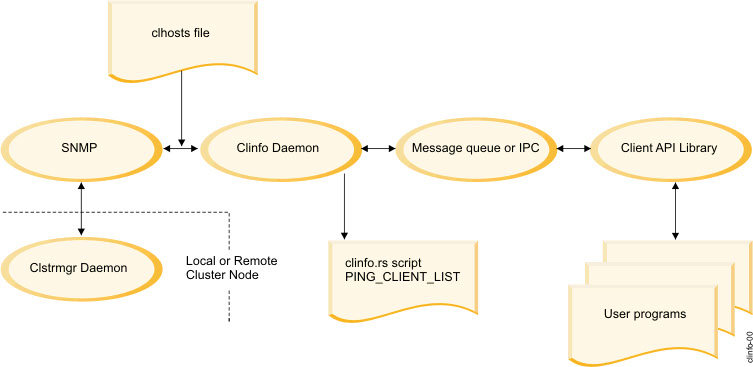
For Clinfo to work as expected, the clhosts file must contain the IP addresses of all PowerHA SystemMirror server and client nodes to which Clinfo can communicate. The Clinfo daemon retrieves its information through SNMP from an PowerHA SystemMirror server node - a node on which the Cluster Manager daemon (clstrmgr) is running. During startup, the clinfo daemon reads in the clhosts file to determine which nodes can communicate through SNMP as follows:
- For clinfo daemons running on the same server as the clstrmgr daemon, it reads in the local server-based /usr/es/sbin/cluster/etc/clhosts file, which only contains the IP address associated with the loopback address.
- For clinfo daemons running on client nodes, that is, nodes on which the clstrmgr daemon is not running, for highest availability, the client-based /usr/es/sbin/cluster/etc/clhosts file should contain the IP addresses of all of the PowerHA SystemMirror server nodes. In this way, if a particular PowerHA SystemMirror server node is unavailable (for example, powered off), then the clinfo daemon on the client node can attempt to connect to another PowerHA SystemMirror server node through SNMP.
If Clinfo does not succeed in communicating with a local SNMP process at startup, it does not get the cluster map and therefore cannot try to connect to another SNMP process.