Learn about the installation requirements for a multiple-system installation.
In a multiple-system installation, it is possible that a floor tile with cable cutouts (refer to Cutting and placing floor panels) will bear two concentrated static loads up to 476 kg (1050 lb) per caster and leveler. Thus, the total concentrated load can be as high as 953 kg (2100 lb). Contact the floor tile manufacturer or consult a structural engineer to ensure that the raised floor assembly can support this load.
When you are integrating a model 9119-590, 9406-595, and 9119-595 into an existing multiple-system environment, or when adding additional systems to an installed 9119-590, 9406-595, and 9119-595 consider the following factors:
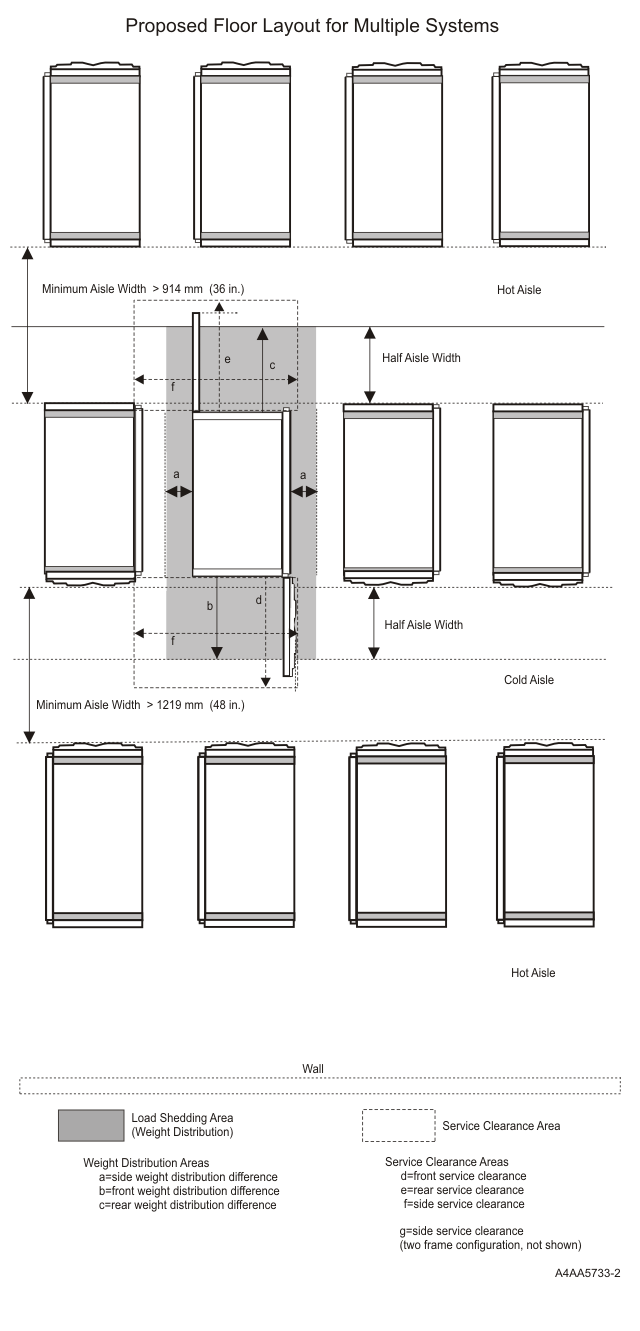
For multiple rows of systems containing one or more model 9119-590, 9406-595, or 9119-595 the minimum aisle width in the front of the system is 1219 mm (48 in.) and 914 mm (36 in.) in the rear of the system to allow room to perform service operations. The front and rear service clearances should be at least 1219 mm (48 in.) and 914 mm (36 in.), respectively. Service clearances are measured from the edges of the frame (with doors open) to the nearest obstacle.
Systems should be faced front-to-front and rear-to-rear to create "cold" and "hot" aisles to maintain effective system thermal conditions, as shown in the following figure.
Cold aisles need to be of sufficient width to support the airflow requirements of the installed systems as indicated in Cooling requirements. The airflow per tile will be dependent on the underfloor pressure and perforations in the tile. A typical underfloor pressure of 0.025 in. of water will supply 300-400 cfm through a 25% open 2 ft by 2 ft floor tile.
 Subscribe to this information