Service management profile: introduction
The service management profile (SMP) distills the best practices for governance across varied business types and industries.
Governance involves modeling your business objects and practices so that everyone in your enterprise follows a predefined set of behaviors in a way that can be controlled and audited.
- Objects
- Lifecycles
- Policies
The following table shows the main types of object available.
| Object | Description |
|---|---|
 |
In any governance process, there must be ownership. The organization object embodies this ownership. Every other object must be owned by an organization, either directly or indirectly. |
 |
A business capability object expresses a business view of a capability that is required within your enterprise. The object describes the business needs and concerns, but not the implementation. The capability can be viewed from a generalized business perspective. |
 |
A capability version is the realization of a business capability. The capability version indicates how the business capability is provided, for example, whether it is a web service, whether it requires messaging, and so on. Aspects of the implementation, such as web service definitions or SCA modules, are referenced from the capability version. |
 |
The service level definition (SLD) describes non-functional, or quality of service, characteristics of a capability. These include characteristics such as how many hours a day the capability is available, or the types of security needed on interactions with the capability. Consider a capability version deployed onto a number of different servers, servicing different types of customer, or different geographies. Each server might not be able to provide the same qualities of service and require unique SLDs. However, each consumer interacts with the capability in the same way. |
 |
If a Capability Version is offered for reuse in your enterprise, a service level agreement (SLA) must be created to describe the details of the agreement between the capability consumer and provider. The SLA is usually a subset of the qualities of service offered by the SLD of the providing capability version. For example, the SLD might state that the service is available from Monday to Friday inclusive, but the SLA might define that the service is only required on Wednesday. |
 |
When a capability version is deployed on a runtime system, it has one or more network addressable endpoints. These endpoints are represented by service endpoints. Service endpoint objects inform the user of the service where the service is available on the network. |
The following example illustrates how the SMP objects relate to one another.
A Credit Check business service is owned by the Common Services organization. This business service has a real implementation in the form of the Credit Check service version, which has been deployed into three geographical locations. Each geographical location hosts the service on a different server and so there is a different SLD for each installation. Each SLD can offer a distinct set of service endpoints for the service.

After the service has been implemented, it can be offered for reuse. Reuse requires a service level agreement (SLA), and introduces the concepts of service providers and service consumers.
The Commercial division
is defining and constructing their own capability called Eligibility
Service. They decide to use the Credit Check capability from the Common
Services organization as part of their own service. The Commercial
division is based in the UK, they negotiate the conditions of the
service interaction and capture the conditions in an SLA named SLA
– Credit Check
.
The following diagram shows the capability version, Credit Check, in a consumer/provider relationship with another capability version, Eligibility Service. The diagram shows the final structure of the main objects in this governance example.
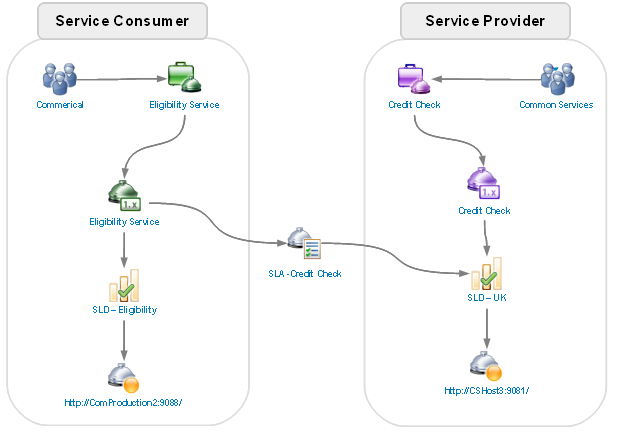
The following topics look in detail at how the Credit Check service was evolved and governed, then at how the Eligibility Service was evolved. It examines how the Eligibility Service governance story takes into account the Credit Check service.
Follow the related links for more information on some of the major concepts involved in understanding the service management profile. Work your way through the SMP tutorials to look at different governance scenarios in more detail. The tutorials also provide more discussion about different implementation types such as SCA and REST.