There are three types of Application Groups (APG) available within Automation Control:
- Basic
- Move
- Server
Basic Groups
Basic Groups manage the resources that are defined to them as if the resources were a single resource. Request that the group starts and all the resources start, stops and it stops all of the resources. If one of the resources fails and cannot be restarted, the group as a whole is broken, which can lead to the group of resources being shut down.
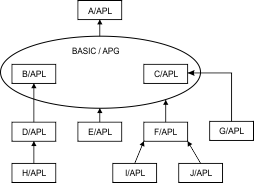
Figure 1 shows a Basic group that contains two applications; B/APL and C/APL. The group is dependent on A/APL application. Neither the B/APL or C/APL application can be started before the A/APL application is up. The E/APL and F/APL applications are dependent on the group, and cannot be started until both members of the group, B/APL and C/APL, are up. The G/APL and D/APL applications, however, are directly dependent on specific group members. These two applications can be started as soon as that particular member is up, and regardless of the state of the other member.
Move Groups
Move Groups manage the availability of a single resource on a single system. The resource is a single APL or is a Basic group (or even a Server Group or another Move group). The group is responsible for picking the member to initially activate and for picking other members to activate as required to maintain its availability.
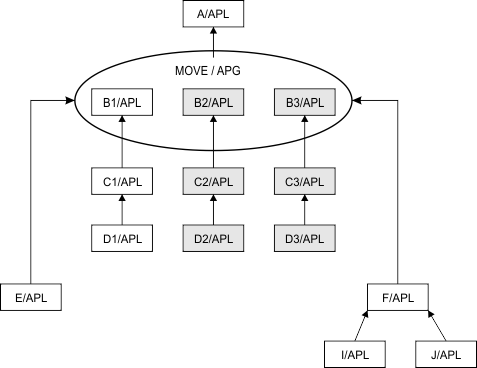
Figure 2 shows a Move group with three alternate members: B1/APL, B2/APL, and B3/APL. Because it is a Move group, only one of these applications can be up at any given time. The group itself is dependent on the A/APL application. It must be up before any of the Bn/APL resources can be started. Again, the E/APL and F/APL applications are dependent on the group. These applications can be started when any one of the three Bn/APL applications is up. The three Cn/APL applications are directly dependent on the corresponding Bn/APL applications. They are only started if the Move group chose to start its Bn/APL parent and that application is up.
Server Groups
Like Move Groups, they manage the availability of resources. A server group gets a set of resource instances and a target number of them to keep available. It is responsible for picking the instances that originally get started and for "moving" them around to maintain availability.
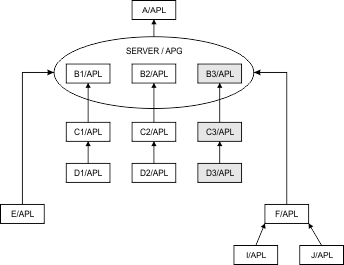
Figure 3 shows a Server group with three equivalent members: the B1/APL, B2/APL, and B3/APL. The Server group’s goal is to have two of its members up, so the third is down. The group is dependent on the A/APL application. None of its members can be started until the A/APL application is up. Again, the E/APL and F/APL applications are dependent on the group. They can be started after two members of the group become available. The three Cn/APL applications are directly dependent on the corresponding the Bn/APL applications. The Cn/APL applications are started if the Server group chooses to start its Bn/APL application and that application is up.
On a single system a Server group can be used in scenarios where, you must be able to dynamically expand and reduce the available capacity that an application presents. This is done by dynamically changing the resources availability target.